by Simon Wu
Wu, Simon. “When Children Start to Doubt.” Global Vision Research, 2024. doi:10.69979/3041-0843.24.2.030.
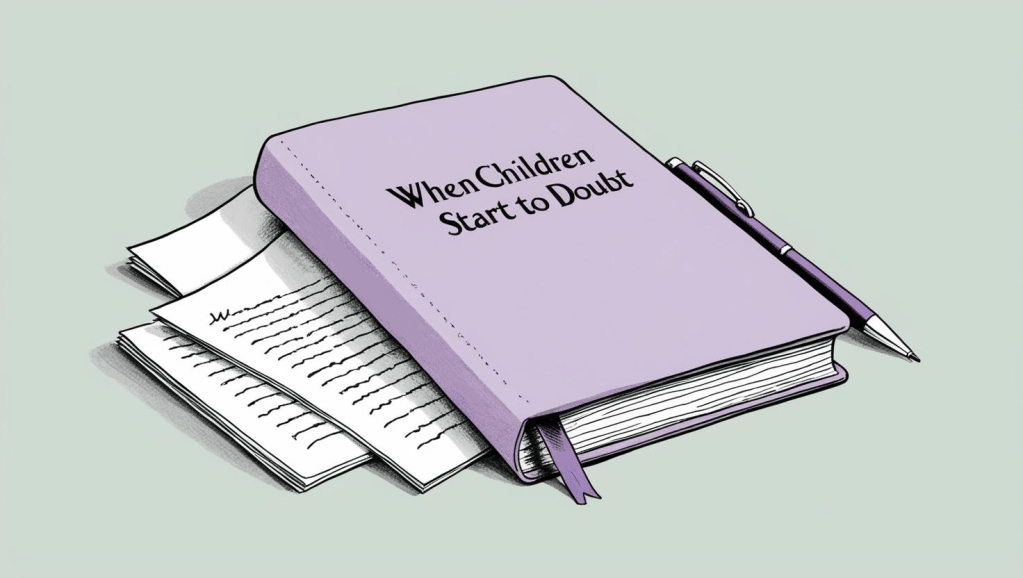
“Ze gwo” Yihan had heard the phrase nine times today. She tried to recall what she was doing each time it was said to her to avoid the tenth. That evening, when she got home, she looked up the meaning of the Cantonese phrase and found out it meant “excuse me, please let me pass.” She wrote it down in her diary and developed a story around it. Yihan’s diary was a soft lavender, its cover made of supple sheepskin that caught the sunlight, reflecting a gentle glow every time it touched the surface. The exterior, inevitably, lent a subtle filter to one’s perception of the contents within. Just like the notebook itself, the moment someone ran their fingers over the smooth sheepskin cover, they couldn’t help but be drawn to it, fascinated by the color, unable to resist flipping it open.
Every short story in Yihan’s journal begins with “I,” yet names like Richard, Lucy, and Michael are nowhere to be found in her real life.
Today, I miss Lucy again, even though it‘s only been a few days since we parted. The last time we talked, she asked if my mom ever doubted my character. I told her I didn‘t know. I don‘t even know what doubt feels like.
She said doubt is like forgetting to close your laptop and coming back to find the page isn‘t the same as before.
But can something already seen, already changed, really cause doubt? Can you call something you‘ve already confirmed doubtful?
I think, maybe doubt is more like what I feel each time I come home after being away for a while and look at the monstera I keep in the living room. Maybe it‘s because my monstera is aquatic that it grows so slowly. Each time I return, it looks exactly the same. Did it really experience nothing at all during all that time in between?
Yihan closed her journal and slid it back onto the neatly packed bookshelf. Next to it were stacks of novels, and of course, a Guide to Learning Cantonese.
Yihan was 16 years old, and this was her first time leaving her home in Beijing to come to Hong Kong. During the last period of her first year of high school, she discovered the thrill of cheating, turning her efforts from studying to avoiding getting caught by the teachers. Clearly, the latter required much less effort. But deception isn’t the same as fiction—people are often more forgiving of set lies they know, even finding pleasure in them. Deception, however, is an unknown lie, something most people despise and avoid. This avoidance might stem from the deceitful nature of the liar, or perhaps from the lack of courage in the deceived. But lies come in two forms—benevolent and malicious, and cheating will never be a benevolent lie! Yihan’s mother, Ruowen, had warned her repeatedly with sternness.
“But we don’t even speak Cantonese,” Yihan voiced her concern.
“The elementary school where I teach is all in English, so I can work in English.” Yihan’s mother countered. “Doesn’t your school offer Cantonese language classes? At your age, you can pick up a new language quickly, and Cantonese is still a form of Chinese, it will be easy for you.”
“But what about our life here, right now? Will Dad come to visit us in Hong Kong?” Yihan tried to ease her anxiety by throwing out more questions, even though she already knew what the answers would be.
Yihan’s mother, Ruowen, was a true Beijinger, but her time studying for a master’s degree at King’s College London had made her English far better than most of her peers in China. However, when she returned to Beijing, the rigid mindsets of those around her stifled the budding London spirit she had developed. She was frustrated by Yihan’s inability to fit in the social culture of Beijing. If Yihan had been a more traditionally Chinese style well behaved girl, Rowen might not have decided to leave so abruptly. If it had just been about Yihan getting caught cheating, she probably wouldn’t have left either. But there’s an old Chinese saying: “Shi Bu Guo San” — three strikes and you’re out. When Ruowen’s colleagues began gossiping about Yihan’s girlfriend, she decided she had to prevent a fourth strike. Hong Kong has the most advanced healthcare in Asia; perhaps they could find a way to treat the daughter’s sexual orientation there, Ruowen thought.
Once one hears something about a person, one attempts to learn more until the information can be compiled into a story. Yet Yihan preferred not to start; she didn’t like the way her mom’s colleagues were always droning on about information that would only make their own stories cliché. Yihan preferred watching the changes in the new leaves of the monstera that had traveled with her from Beijing to Hong Kong, rather than sharing her gardening successes with others. She believed that talking to people about it wouldn’t do anything to help the monstera grow, but speaking to it every day in a new language might actually make a difference. She also shared with her girlfriend, Xiyu, who was still in Beijing, that she was learning Cantonese.
“Hai ya,” Yihan explained to Xiyu, saying it meant “yes.” But she exaggerated the tone playfully, mimicking the way some Hong Kong locals struggled with Mandarin pronunciation. Every time, Xiyu burst into laughter. But after a while, Yihan began to seriously share many Cantonese-specific terms and expressions that had no equivalent in Mandarin. Xiyu’s initial excitement about these conversations waned as Yihan’s enthusiasm for Cantonese grew. Everyone’s life is already filled with things they need to learn for themselves—who has the energy to delve into a world so far removed from their own?
I especially love sending Lucy voice messages. Unlike texting, it lets her hear the proper Cantonese pronunciation of every word, and it keeps her from misunderstanding my tone.
But why doesn‘t she like sending me voice messages?
I guess it might be because, unlike me, she doesn‘t have a habit of writing. She can treat our conversations as her space for writing.
Words are fascinating. They lack images and sound, yet they can express so much more emotion—and hide just as much.
“Hang fuk si gwong jing goi hai seon gaan m hai wing jyun.” Yihan’s mother pointed at a sticky note on Yihan’s desk and asked Yihan what this sentence meant. “A good time means moment rather than forever,” Yihan explained. She quickly left the room to prevent her mother from asking more questions. Ruowen had already forbidden her from contacting Xiyu, and if it was discovered that they had only broken up on the surface, Yihan’s phone would definitely be confiscated. Yihan realized that she wasn’t falling in love with Cantonese only because of the people or the culture here, but because it could be her secret language, a way to keep her mother at a distance.
Ruowen arranged for Yihan to see a psychologist named Lilia, with whom she would have weekly sessions. Initially, Lilia refused Ruowen’s request, explaining the diversity of gender identity and sexual orientation. And emphasized that this is not a disease. But Ruowen refused Lilia’s explanation in the same tone, insisting that her daughter needed therapy for various other reasons as well. Lilia was the only staff member here who could speak Mandarin. Ruowen had signed up for the most expensive treatment package, and they agreed to the arrangement.
Lilia’s office was in the newly built K11 Musea building, with a patient’s seat positioned just right to overlook the Tsim Sha Tsui Promenade and the bay. This view was the reason Yihan was willing to come every week—it was a sight she could never experience in her landlocked hometown of Beijing. Sometimes, she would let her eyes drift past Lilia, focusing instead on the sea beyond, losing herself in the scenery. Lilia noticed every when Yihan’s mind wandered, but she never interrupted Yihan’s attention.
“I feel like I’ve become a princess, just like Sasha in The Princess of Nebraska, Hou hang fuk!” Yihan said in a voice message, excitedly sharing with Xiyu after her first therapy session.
“But I’m not like Yang, I can’t make you pregnant,” Xiyu texted back.
“But we’re not as far apart as they are,” Yihan also sent the text message, unsure whether Xiyu was teasing or upset.
“It’s less than 20 hours to fly from the US to China. Right now, if we want to meet, it would take us 14 days—336 hours. Can you really say they’re farther apart?” Xiyu’s text message came through again, and Yihan stared at the screen without replying.
“But last week you said you enjoyed the way you and Xiyu talk. Hasn’t it always been that way?” Lilia pull Yihan’s focus back from the window. She was puzzled by Yihan’s shift in attitude toward Xiyu. Yihan’s emotions seemed as unpredictable as the constantly changing lockdown policies. Mainland China began a strict embargo after an outbreak of COVID epidemic in Wuhan. While Hong Kong had yet to be heavily impacted, returning to the mainland required a 14-day quarantine in a hotel before being allowed home.
Indeed, who can say that 20 hours is farther than 14 days? The 14-day quarantine was like replacing the border fence between Hong Kong and mainland China with a thick wall. What had once been easy to cross now required an enormous amount of time to overcome. Even though Yihan, after coming to Hong Kong and before the pandemic, had not yet crossed that fence to visit Xiyu, she knew she could if she wanted to. But now, this wall would muffle her voice, dulling its clarity and tone; Xiyu continued her usual habit of texting, but started relying on the chat app’s voice-to-text feature to quickly skim through Yihan’s voice messages. This also allowed her to avoid letting her growing frustration with Yihan surface. At the same time, however, the emotional shifts in Yihan’s voice were also buried within the converted text. Xiyu stayed unaware, rooted in place, While Yihan stood lost, raised in a new space.
“Gam gok ngo mou zi cin oi keoi.” Yihan told Lilia, as her mother came to pick her up, that she already sensed that the relationship between her and Xiyu had become different.
“Gan zyu zi gei ge sam zeoi gan jiu,” Lilia responded in Cantonese, urging Yihan not to be sad, and to stay true to her own heart.
“What were you just talking about? Lilia promised me she could work in Mandarin.” Ruowen asked Yihan on the drive home, a hint of suspicion in her voice that most people wouldn’t notice, but her daughter, who knew all the nuances of her mother’s emotions, did. Even though she had to sit in the back seat today because her mother had filled the front passenger seat with bags, she could still sense it through her mother’s tone and the pace of her breathing.
“I’ve learned Cantonese now; we can communicate in the language that feels most comfortable,” Yihan explained.
“But that’s not fair, is it? It’s comfortable for her to use her native language, but you have to adapt,” Ruowen replied, her attention mostly consumed by the crowded roads and traffic lights, leaving little room to spare for Yihan.
“Shit, waiting for another two-minute red light!” The light’s interruption gave Ruowen a brief moment to meet Yihan’s gaze in the rearview mirror.
“You’re the one who wanted me to learn Cantonese,” Yihan felt compelled to break the silence between them.
“I thought it would make things easier. You could have simple conversations with Hongkongers who don’t speak Mandarin or English. But when you meet someone who does, and I paid her to work for you. Isn’t it more comfortable to use your mother tongue?” Ruowen’s rapid-fire words left Yihan no chance to interject.
“Why do you think what makes you comfortable would make me feel the same?” Yihan asked. The green light flashed on, and Ruowen didn’t respond; she accelerated, ending the conversation.
After work, Ruowen would take off the structured, commanding coat she wore at school, but paradoxically, she seemed even more serious at home. At school, she was never as impatient as she was behind the wheel, especially since moving to Hong Kong. She didn’t want her temper to jeopardize her position at the new school. There, Ruowen was adored and deeply respected by her students, who saw her as a graceful and intellectual maternal figure. Yet none of them had ever opened her notebook to see what lay inside.
In this way, Yihan and her mother were remarkably alike. At her new school, Yihan got along well with both classmates and teachers, but no one had ever opened her notebook either. The only people who had seen the contents of each other’s notebooks were Yihan and Ruowen. Yihan was coming to understand more and more of her mother’s writings, while Ruowen found herself increasingly out of touch with her daughter’s thoughts.
This wasn’t the first time tension had built between Ruowen and Yihan in the car. But the confined space pressed down on the atmosphere, with the roof seeming to weigh heavier on them both. The last time they were in the car together, Ruowen had told Yihan that their beloved dog, Mia, who had been with them for 15 years in Beijing, had passed away due to illness. Yihan had initially frozen, then burst into uncontrollable tears, her sobs sharper than the blaring of car horns outside. Ruowen was unsettled by Yihan’s reaction, just as Yihan was equally troubled by her mother’s demeanor—particularly the way Ruowen interacted with Yihan’s grandmother, which felt strangely distant and unfamiliar to Yihan.
Yihan’s grandmother, during a video call with Ruowen, mentioned that she had been searching for short social media videos about Labradors recently, but since she didn’t know how to use search engines, she could only access automatic recommendation platforms in China. She asked Ruowen to send her some videos. Ruowen felt annoyed by this request. She scolded her mother for being overly melancholic and repeatedly urged her to stop watching the videos. “Older people have poor eyesight and can’t distinguish bad influences.” But did blindness necessarily mean a worse sense of direction? Yihan’s grandmother didn’t mention how much she missed Mia, nor did she express how happy she was to see the Labrador videos. She didn’t even criticize Ruowen’s sudden bursts of temper. Yihan found this just as puzzling.
The new leaves of Yihan’s monstera were gradually turning deep green, and through the transparent glass pot, she could see its roots growing longer. Perhaps the subtropical climate of Hong Kong was better suited for plants, and Yihan felt that the monstera, like everything around her, was changing rapidly. The only thing that had given her a sense of stability lately was Lilia. Yihan started speaking English as much as possible outside the therapy room with Lilia, to prevent her mother from replacing Lilia with an older, more distant therapist. After their session, they strolled along the Tsim Sha Tsui Promenade, waiting for Yihan’s mother to pick her up. Yihan was ten years younger than Lilia, but ten centimeters taller. For the first time, Yihan walked close enough to see Lilia’s face from the side, noticing how her delicate nose and double eyelids made her even more captivating.
“I haven’t figured out how to write an ending for that relationship in my journal,” Yihan murmured, not really expecting a response from Lilia. People always imagine a thousand possible reasons for a relationship to sour, but what actually happens is always the thousand-and-first. She didn’t owe it to herself or Xiyu to come up with a perfect explanation for their breakup, let alone to her journal.
Lilia turned to face Yihan and gently caressed her cheek, like a tender mother soothing her infant. Yihan looked at Lilia earnestly, wishing her hand would linger just a little longer.
“You don’t need to overanalyze the reasons for the breakup. Writing in a non-native language, encrypting your emotions with fictional stories—that’s exhausting enough. Adding logical reasoning to it all is too much,” Lilia said.
Indeed, reasons were like fragmented clues, and logic only amplified the deceit within a story. But was it a benevolent deceit? Yihan couldn’t be sure. She paused, leaning against the railing by the sea. The warm, humid air of early autumn left her drenched in sweat. She noticed a single bead of sweat slipping from her hair, dropping into the sea below, vanishing without a trace.
Early autumn in Beijing was just as hot as in Hong Kong, but in Beijing, it was a dry heat, while Hong Kong’s heat was humid. In Beijing, her sweat would have evaporated instantly on the ground; in Hong Kong, it merged with the sea. Neither of them caused any harm nor offered any help. Maybe that thought could go into her journal, Yihan thought, holding onto Lilia’s hand.
Yihan was deeply moved that Lilia didn’t pull away from her touch, though Lilia neither said nor did anything in response. Even so, Yihan felt it was enough. She wished they could be like droplets of water falling into the sea or evaporating into the air, unnoticed by anyone. What comforted Yihan, however, was the realization that the feelings she had for Lilia had never existed before her breakup with Xiyu.
After Ruowen picked Yihan up and brought her home, Yihan noticed that tonight’s dinner was unusually lavish. Her mother’s mood was as bright as the colors of the dishes. “Did you get a promotion or a raise?” Yihan teased.
“No, neither. Why would you think that?” Ruowen asked, puzzled.
“You seem to be in a really good mood today,” Yihan said. Ruowen just smiled, not responding directly, and instead started talking about the students she’d been teaching recently. Yihan nodded and made affirming sounds, but her mind had already drifted elsewhere. It wasn’t that she wasn’t interested; she was more preoccupied with why her mother seemed so happy. Did she know about the breakup with Xiyu? But how could she know? Had her mother snooped through her phone? But Yihan’s phone password wasn’t based on any family member’s or her own birthday—Ruowen couldn’t possibly know it. Maybe her mother had installed some kind of monitoring app? But was that even technically feasible? Yihan’s mind raced through new possibilities.
When a child’s mood shifts for no apparent reason, parents inevitably start to doubt. In the same way, as children grow older, they start to doubt their parents.
“Ni paai jau mou sin pang jau?” Ruowen suddenly blurted out in heavily accented Cantonese, jolting Yihan out of her thoughts.
“Do you mean ‘san pang jau’? Of course, I made new friends. Are you learning Cantonese?” Yihan corrected her mother.
“I’m not deliberately learning it,” Ruowen explained. “There’s a boy in my class who also transferred from Beijing recently. He doesn’t speak Cantonese, so I paired him with a student from Guangzhou to teach him some basic phrases. I just picked up a couple myself by listening.” She hesitated for a moment, then added, “He’s a really well-behaved kid, and quite handsome too. It’s a pity there’s such a big age gap between you two. Otherwise, once you graduate, I could introduce you. Who knows, you might hit it off.”
Yihan quickly shoveled down her last bite of dinner, then bolted to her room, slamming the door behind her. She was furious that her mother, despite knowing she’d get upset, still chose to keep saying.
There are a few types of parents in this world. Some choose to ignore their child’s doubts, and from there, they grow further and further apart. Others gradually notice their child’s doubts and attempt to reshape the relationship. Ruowen was deep in thought, wondering which type she would go. Every time Yihan emerged from the shower with puffy eyes, Ruowen could find she had cried, using the sound of the water to mask her sobs, letting the shower wash away her tears so mother wouldn’t notice. But Ruowen never spoke it out, never made things awkward. Bad writers are often judged for the falseness of their fiction except by their parents. But a mother can never be the best reader for her daughter, so a mother will not hold on to some bad disguise of her daughter. Ruowen would just reflect on whether she had been too harsh or had put too much pressure on Yihan recently. Ruowen noticed Yihan’s eyes becoming puffy more often, and with that, her reflections grew too.
This week, Yihan started taking the subway to and from her therapy sessions on her own. She was surprised that her mother agreed to the request without any argument. Yihan had been bracing herself for a fierce battle, ready to fight for more time with Lilia. She wasn’t exactly sure when her feelings for Lilia started to grow or when they shifted from mere affection to something more like love. So many things in adolescence spiral out of control—the things one prepares for never happen, and the things one doesn’t prepare for often do.
“No matter what happens, your mother will always love you,” Lilia had said when they were by the sea. Yihan knew Lilia would never make such absolute statements during working hours.
“But can love and like be the same? Does my mother like me?” Yihan asked, her voice tinged with worry. She found it endearing to watch Lilia carefully consider how to comfort her; she liked how much Lilia cared.
Ever since Yihan had come out to her mother about preferring to present herself in a more masculine way, and since Ruowen had discovered her relationship with Xiyu, their relationship had grown increasingly distant. Though Lilia had no intention of providing any sort of conversion therapy for Yihan, she genuinely hoped to bridge the gap between Yihan and her mother. But how could Lilia, who had never experienced the dynamic between Yihan and her mother, hope to mend something so fragile?
Before her mother first insisted she go to therapy, Yihan had fiercely resisted, gathering countless articles from the internet to try to convince her mother that being gay was not a disease that needed treatment. It was a natural part of who she was. Yet Ruowen had remained adamant, insisting Yihan see a therapist no matter what.
Whenever Yihan lay on her small bed in Hong Kong, staring at the ceiling, she often wondered—did her mother truly not understand? After all, this was entirely normal in the UK. Was her mother deliberately making things difficult for her? Time and again, Yihan tried to stop herself from thinking this way. But at the same time, was her growing fondness for Lilia a form of rebellion? Yihan wondered, if her mother ever found out, would she see it that way?
On Saturday, Yihan hurried excitedly from the subway station toward Lilia’s office. But as she reached the ground floor of the building, she caught a glimpse of her mother, Ruowen, stepping out of the elevator. Startled, Yihan quickly moved to the side and hid. What was her mother doing here? Yihan was puzzled. She had assumed Ruowen had left early for a school meeting.
Only after watching her mother leave the building did Yihan rush to Lilia’s therapy room. She hadn’t avoided her mother out of fear of exchanging pleasantries but to prevent Ruowen from calculating the exact time it took to reach the therapy room and using that to blame Yihan’s late return home entirely on her commute.
Yihan hadn’t planned on asking Lilia about what had just happened, but Lilia immediately noticed the weight on Yihan’s mind. It was a mood she recognized all too well, reminiscent of the time before Yihan’s breakup with Xiyu—an emotion that had stirred in Lilia something close to a protective, almost pitying emotion. Lilia placed a hand on Yihan’s shoulder, but Yihan, still lost in her thoughts, flinched and pulled away, startled. Her eyes darted to the door, and only after confirming that no one was outside did she relax.
“Ngo maa hai dou zou me?” Yihan whispered as she leaned closer to Lilia. She decided she had to find out why her mother had come.
“Oh, did you two just run into each other? No wonder you seem off today. Did you argue?” Lilia responded in her usual work tone, which made Yihan feel even more puzzled. Lilia had never disregarded Yihan’s language choice before.
“No, but I saw her leaving. So what was she doing here?” Yihan persisted, unwilling to be sidetracked, determined to get back to her original question.
“Nothing much, she just wanted to ask how you’ve been doing recently.”
“And then?”
“And then, of course, everything’s fine. I just told her the truth, didn’t I?”
Everything? The truth? Yihan felt these were the most uninspired words Lilia had ever said since they met, utterly unworthy of being written down. It was pure cliché. But isn’t life itself made up of countless clichés? Yihan thought. Somehow, she thought of her mother’s colleagues. She didn’t press further, nor did she argue. She wished for an eagle to suddenly slam into Lilia’s office window, shattering this awkward conversation, just as one had done when she and her mother first moved to Hong Kong. Back then, her mother had been about to hang the freshly washed clothes on the balcony when a massive eagle—something they’d never see in Beijing—slammed into their balcony glass before flying away. If her mother had been just a second quicker, she might have ended up in the hospital, or dead. But here and now, the windows were sealed tight, and no one was near them, providing the safest possible conditions for an eagle to strike. This was the most powerful way to break the awkwardness and ignite Yihan’s affection for the person she loved. Yet, eagle fate isn’t something one can control—no more than the fate of a human.
Yihan decided not to overthink it anymore. After today’s therapy session, she invited Lilia for a walk. They walked along the streets following the subway line towards Yihan’s home. How many stops they’d walk depended on their stamina. This way, they wouldn’t stray too far from their destination, and the way would feel less lonely. As they walked, they saw people feeding pigeons by the sea, others feeding stray cats by the roadside, and even encountered someone on Nathan Road lifting a limping dog from the ground in search of a vet. They walked quietly along the road, neither of them speaking. For the first time, Yihan noticed how much there was to see when they weren’t talking, things she had never paid attention to before. Normally, two girls walking arm in arm wouldn’t attract much attention, but Yihan’s short hair, sweatshirt, and jeans, combined with the height difference between them, drew a few glances.
When Yihan returned home, her mother had not yet come back. She sat down with her journal, making up the story of the day onto its pages.
“Why do people always seem more willing to help a stray animal than a stranger?“ Yihan asked Lilia.
“Because stray animals don‘t require responsibility,“ Lilia replied. “Admiring and petting them is enough. Responsibility means trouble and most people would rather grow colder than deal with that.“ Yihan linked her arm with Lilia‘s.
“True, attention is already a rare commodity; extending a hand is asking too much. It puts pressure on both the helper and the helped. The family already gives us enough pressure, don‘t they?“ Yihan‘s pessimism felt older than her years. She thought to herself, it‘s a good thing her father didn‘t come to Hong Kong too; otherwise, she‘d be carrying twice the weight of pressure and responsibility.
“Not all parents believe that they alone bear the responsibility and pressure, while their children simply enjoy. Some realize that this sense of responsibility is mutual, a two-way street. So, we should be more forgiving of those who seem cold; their families have already placed enough burdens on them, and they‘ve given those burdens in return. The passionate ones might just have escaped from their families,“ Lilia said.
“But your mother can‘t be indifferent to her students, and she didn‘t turn your Mia into a stray dog, so where can she place the burden?“
The last sentence Yihan wrote heavily, as it was the question Lilia had really asked her today, one she hadn’t answered. Yihan tore the page from her journal, shredding it into pieces before throwing it into the trash, then ripped up a few draft sheets to cover it all.
Ruowen came home later than usual today. As soon as she entered, she went straight to the kitchen to cook. Yihan stepped out of her room and noticed a slightly crumpled corner of paper peeking out from her mother’s bag on the sofa. Quietly, she walked over and gently pulled out the paper. Boldly written at the top were the words “Anxiety Disorder Counseling.” Yihan quickly folded the paper back, but then opened it again. She skimmed through every word on the report, making sure she hadn’t misread, and trying to gather as much information as possible before her mother left the kitchen. Her hands trembled slightly as she carefully folded the paper and placed it back in the exact same spot. Turning around, she saw that the kitchen door was still closed. She didn’t approach it; instead, she walked back to her room.
Yihan sat down and opened her journal, beginning to write in English. Writing in Mandarin carried the weight of native-language shame, and Cantonese felt too distant from her mother. Of course, Yihan didn’t choose English to make her journal accessible to her mother; she had decided to write with more sincerity in her fiction diary, even though she didn’t mind if her mother ever read it. Each time Yihan returned to her room, the journal remained untouched, in its spot on the second shelf, far right. Maybe her mother had opened it, read it, and placed it back exactly as it was, or perhaps she had never touched it at all. Doubt is like a seed—curiosity makes it sprout, exploration makes it grow, and action makes it bear fruit. But even if you kill one curiosity, abandon one exploration, or prevent one action, countless other factors can still nourish that doubt. Likewise, when a seed sprouts, it will change the soil, release oxygen as it grows, and flower before it bears fruit.
 Simon Wu