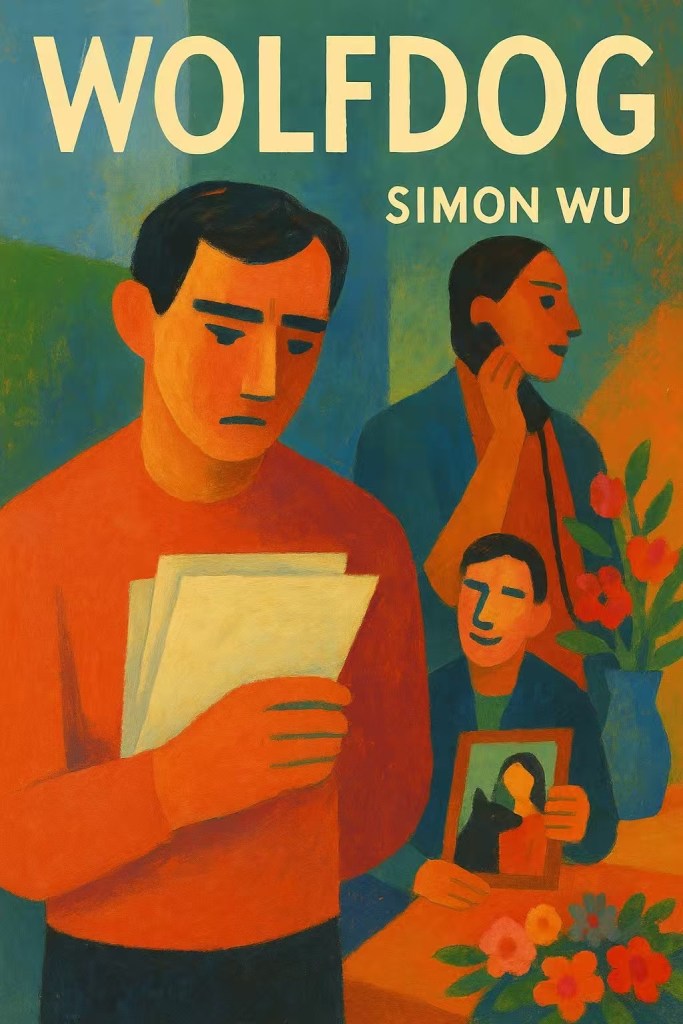
Wu, Simon. “Wolfdog.” Lecture Notes in Education, Arts, Management and Social Science 3, no. 3 (2025): 155–62. doi:10.18063/LNE.V3I3.834.
“We stood there, gazing at each other, unmoving. I had no idea how long this quiet looking could hold us together, but the arrival of new life, somehow, allowed the days to keep going.”
Lucas furrowed his brow and underlined the sentence and raised his voice toward Mei, who was across the room on the phone. “The atmosphere at the end of your novel is beautifully rendered,” he said. “But I don’t think that kind of tone really translates on screen. Can we end with the two of them embracing instead?”
“You’re the director,” Mei replied, pressing her hand briefly over the mic before speaking to him. “You can design anything you want for the film.” She was caught in a long-winded call with a prop rental company and turned swiftly, walking away in the opposite direction without waiting for a response.
Lucas’s gaze trailed after her, then fixed on a man stepping through the door—a stranger, wearing a baseball cap just like his own. Mei pulled a picture frame from a prop crate and handed it to the man, pointing to a spot on the wall behind Lucas. As the man came closer, Lucas froze.
Even with part of his face obscured by the cap, Lucas could say—without exaggeration—that the man might as well have shared the same face as Mei’s ex. The only difference was the gender. Startled, he turned to Mei—only to find her already looking back at him with the same expression of disbelief. Anyone else on the crew might have missed the subtle shift in Mei’s face. But Lucas could read her—just as clearly as he could read what the man was holding: a childhood photo of Lucas and Mei at age three. Mei, her hair in two bouncing pigtails, stood laughing directly at the camera, gleeful and unguarded. Beside her, Lucas sat on the ground, gripping the edges of a tiny, ill-fitting girl’s hat perched on his head. The same gentle smile played at his lips, but his eyes weren’t on the camera—they were on her. Lucas thought: if this moment and that photo ever appeared together in a film, they’d be dismissed as cliche.
“Director Lin, hello, I’m the new art assistant, Wilson.” Lucas snapped back to the moment only when the man spoke.
“Oh, just call me Lucas,” he replied, then gestured at the photo. “Why are we hanging this up? The main characters didn’t know each other as kids, and they didn’t raise the children either.”
Lucas’s question was directed at Wilson, but his eyes were on Mei.
Mei was still on the phone, her voice tight with negotiation. Without a word, she pointed again at the wall, this time more insistently.
Lucas could read her, just as he always could, ever since the day this photo was taken. Her gestures were sharper than Serena’s, her pace quicker. Especially when she was upset, her turns had the speed and precision of Ruby, the lovable Labrador raised by Serena and Zoe in the novel. The thought made Lucas smile, despite himself.
As Wilson prepared to hang the frame, Lucas reached out and snatched it from his hands—a gesture more decisive than his thoughts had been.
“Have you ever thought about acting?” Lucas asked, excitement flaring as he scrolled through Wilson’s resume on his phone, Lucas noticed there was indeed no photo—but two brief student film acting credits were listed. His excitement was unmistakable.
“I can?” Wilson’s eyes lit up, and tone lifted, noticeably brighter than it had been when he was hauling props.
“I think you’d be a great Zoe.” Lucas said.
“The script’s changed a bit, I’ll send you the shooting script. For now, maybe set the novel aside.” Lucas passed the printed copy in his hand to Wilson while still scrolling for the digital version.
Zoe’s been changed into a man. Lucas and Wilson said it almost in unison. Indeed, making a film in a country where queer representation is strictly banned felt like walking a Labrador past someone with a deep fear of dogs. No matter how gentle or adorable the dog might be, that person would still flinch and flee.
It wasn’t until the sun slipped past the top of Wilson’s head and hit Lucas square in the eyes that the clatter of his typing finally stopped—only then did he realize that evening had already arrived. Strangely, the light now was heavier than at noon, thick enough to catch in the rising dust, each speck visible in the golden air. Lucas lifted his heavy laptop in one hand and, with the other, brushed through those dust particles—weightless, almost suspended—as he made his way toward the hotel where the crew was staying.
“You’re pulling my assistant right before we shoot—what the hell does that mean?”
Mei burst into Lucas’s room not long after, her voice sharp with fury. Lucas can feel it—Mei has been holding a quiet resentment toward him ever since last year.
“We don’t have much time left,” Lucas said, keeping his tone even. “Do we really have a better option?”
He sat down in the chair near her, picked up a pomegranate, and focused entirely on peeling it, letting the red juice stain his fingers rather than meeting her gaze. Mei didn’t respond. She walked to the window and lit a cigarette.
“I already asked the producer to find you another assistant. I know you didn’t know what he looked like either,” Lucas said. I chose him for the sake of the project. Don’t overthink it.” Lucas finally looked up at her, chewing a ruby-red seed.
“I remembered you didn’t eat pomegranate,” Mei said after finishing her cigarette, stepping forward to take a few seeds Lucas had already peeled.
“You tell me every day how delicious it is. The producer happened to buy some, so I figured I’d give it a try,” Lucas replied with a grin.
Lucas was a little surprised that Mei hadn’t stayed quietly upset—neither about Wilson, nor the changes to the ending. “A life enters another life, and both are altered,” she said before leaving the room. Lucas wasn’t sure whether she was talking about the two of them, the script, or perhaps both. Maybe their two lives had already reached a kind of balance, one where they no longer changed each other. And yet, something had shifted in Lucas today, a faint tug of movement beneath the surface.
There are usually only two outcomes of conflict—either it brings people closer or it hastens their separation. Was there really no third possibility? It was already the first day of shooting, and Lucas was still obsessing over a character’s line. But time never waits. It pushes everyone forward, evenly, indifferently—whether they’re ready or not.
Between lighting changes and set adjustments, Lucas chose to stay with the actors. He had come to notice that most of the crew were good at disguising themselves, slipping easily into roles of efficiency and detachment. He found it especially irritating that Mei continued to call him “Director Lin” on set. Lucas had always preferred living honestly in a fictional world to pretending in the real one. But as the director, he too had a part to play. The only comfort was this: he could always tell when someone was faking—and none of them could see through him. That meant his own performance, at least, was working.
“Is this the dog we’re using?” Wilson asked during the lunch break, holding up a photo on his phone. It was a picture Mei had sent him—of a strong, almost intimidating wolfdog. Lucas stared at it, puzzled. Even if the lesbian couple in the novel had been rewritten as a heterosexual pair for the film, he had assumed they’d at least keep a sweet Labrador, or maybe a gentle Golden Retriever. Was this even a dog? It looked more like a wolf.
“Does Mei think this works?” Lucas didn’t raise his voice at Wilson, but his irritation was obvious. Why had Mei sent the photo to Wilson first, instead of discussing it with him directly? The thought flashed through Lucas’s mind and startled him—yet almost immediately, his focus shifted back to the more pressing concern: the choice of the dog actor.
“I was just about to show you. It’s the only dog that’s actually pregnant,” Mei said quickly, stepping in.
“If we use a wolfdog to play the novel’s Labrador, no one’s going to buy it,” Lucas said. “What if we switch to a non-pregnant dog? Maybe we can add puppy sounds in post.”
“There’s no time now,” Mei replied, visibly frustrated. “You insisted earlier that the dog had to be genuinely pregnant. All the other trained dogs are booked. Unless… we change the plot again?”
“No,” Lucas said, exhausted. “Let’s go with the wolfdog. We’ve already started filming. Let’s not touch the script anymore.”
“The Russian film adaptation of War and Peace was rewritten during the shoot,” Mei said, giving Lucas a pat on the shoulder.
“But we’re not shooting a war,” Lucas interrupted, though he returned the gesture, patting her shoulder in encouragement.
The weather doesn’t take heart from human reassurance. That afternoon, heavy rain fell without warning, forcing the entire crew to cancel the outdoor shoot. The lighting team hurried inside to set up for an interior scene, and the call sheet was pushed back by an hour. Another unlucky coincidence—yet another cliche. Serena and Zoe will never fight in the rain. Lucas thought.
“I heard your dog passed away last year.” Lucas was startled—first by Wilson’s sudden appearance, then by the question itself.
“Mei told you?” Lucas replied, his voice measured. He had a habit of asking questions when confronted with grief; they worked like an umbrella, shielding him from the downpour while giving him space to study the shape and sound of the rain.
He knew Mei still hadn’t forgiven him for what happened. His dog, Mia, had died right before one of his short films was set to shoot. He had chosen euthanasia. Mei had stayed with him through those final days, keeping him company in the quiet, unbearable stillness of his apartment.
It was Mei who named her—Mia. She said it made the dog feel more like hers. But a name is just a name. Things that are written down are never as cruel as the ones that happen by chance in life. Grief is a terrible thing; it’s like black ink that seeps into all other colors and turns them dark. Back then, Mei poured that ink into her palette by the handful. Every time she looked at Mia for too long, she’d turn away and cry.
Lucas always wondered if she did it so he wouldn’t see her unravel, or if she herself was trying to avoid the weight of what she felt. As for him—he did everything he could to keep his palette clear. He needed to stay composed, needed to make sure everything for Mia’s last days was handled gently, correctly.
He still wasn’t sure if the decision to euthanize Mia had been the right one. But when even the most gluttonous version of Mia began refusing food and water, Lucas thought—she’s made her choice.
Most people fear the unknown, and then use sorrow and blame to chase that fear away. But Lucas didn’t want to reject anything Mia made him feel. He simply lifted his chin toward the days ahead and tried to breathe a little deeper.
“I’m not sure I understand death any deeper than I did last year,” Lucas said to Wilson, “but I know my life has moved a little farther since then.”
Wilson pulled him into a warm embrace. Lucas didn’t lift his arms to wrap around Wilson’s waist—instead, he let them hang loosely by his sides, allowing himself to be held. His breath, soft and warm, landed on the curve of Wilson’s neck, and Wilson, in turn, gently warmed the edge of Lucas’s ear with his own breath. Two warm bodies, drawn close, made even the damp, cold air of the rainy afternoon feel less cruel. Before the cameras rolled, they gently stepped apart—as if to prevent any third person from stealing that warmth.
By the time the lights were fully set, the rain still hadn’t let up. Life, unlike film, couldn’t be cut and stitched together at will, and Lucas knew he couldn’t rearrange time. So he had no choice but to skip the easier outdoor scene and move straight to a heavy interior one.
On the director’s monitor, Serena sat alone on the sofa. Then Wilson entered the frame, his voice low and measured: “Thank you for forgiving me.” His tone was subdued, agreeable.
Lucas frowned. The scene from the script rose vividly in his mind: Serena had grabbed Zoe’s hand; Zoe had pulled her into an embrace and kissed her—impulsive, raw. And then, the two of them were meant to cry together.
“Cut,” Lucas called out suddenly, his voice slightly hoarse.
Wilson, who had just reached out to hug Serena, turned toward the monitor. “What’s wrong?”
“You’re playing him too flat,” Lucas said, rising to his feet and walking onto the set“The scene happens right after their dog gives birth. Both of them should be moved by the arrival of new life. Their reconciliation should feel more intense. Otherwise, the audience won’t feel it.”
Wilson didn’t respond with the same easy agreeableness he’d shown during the break. “But he knows that once something breaks, it doesn’t just disappear. Even if you glue the mirror back together, the cracks remain. I think what he’s feeling is more a kind of resignation toward life.”
“Acting is about showing action, not just emotion!” Lucas’s tone grew firmer. “Do it my way—one more take.”
Lucas had to admit, he was impressed by Wilson’s skill. Even when performing in a way he didn’t fully believe in, Wilson could still make it come alive.So during the second take, Lucas’s brow gradually eased—until the moment Wilson’s lips met Serena’s. Only then did a faint furrow return, so subtle he didn’t even realize it himself.
“We got it,” he murmured.
Outside, the rain had stopped. A red maple leaf, still clinging to beads of rainwater, drifted slowly down. If it had landed randomly on either Wilson’s side or Zoe’s, it might have tipped an invisible balance. Mei caught the leaf mid-air and handed it to Lucas. He took it gently and pulled her over to the monitor so they could watch the playback together. Lucas knew that no matter what kind of conflict had passed between them, Mei would still be the one to hand him the leaf that could tip the balance—and he, in turn, would always do the same for her.
To avoid the risk of more rain, Lucas, following Mei’s suggestion, decided to film the scenes involving the dog ahead of schedule.
The next day, Ruby—the wolfdog version—arrived on set in the back of a black cargo van. Her mood was volatile. The moment the back door swung open, she lunged out with alarming aggression, charging straight at Mei.
Lucas ran forward in panic, but Wilson was faster—he grabbed Mei and pulled her out of harm’s way just in time. The trainer scrambled out after, finally managing to restrain Ruby. Lucas’s eyes fell on Wilson’s hand, still gripping Mei’s arm. Without a word, he called the trainer over, then turned sharply toward the set.
When Mei and Wilson walked in a few moments later, Lucas merely asked Mei with concern. What fault was Wilson’s to begin with? Lucas no longer wanted to wrestle with the tangle of emotions inside him. He could feel how these scattered thoughts were interfering with his filmmaking. So he pushed them down with force—and called for everyone to get ready for the next shot.
Soon, Ruby was led to the center of the living room set, now styled to look deliberately chaotic. Once the camera and lights were in place, the trainer unhooked her leash and moved quietly to a spot just outside the frame, gesturing commands with practiced precision. But Ruby wouldn’t follow. Instead, she curled into herself on the floor, restless, almost anxious.
The trainer looked baffled. He walked over to Lucas and said, “She’s usually an excellent performer. I’ve never seen her disobey like this.”
Just as Lucas was about to step forward, Ruby suddenly convulsed, then collapsed onto the floor. A stream of blood pooled beneath her tail.
“Call the animal hospital—now!” Lucas shouted. Mei was already dialing the number the second the words left his mouth.
On the way there, Lucas and Mei sat on one side of the van, Wilson on the other. Mei held Lucas’s hand tightly. Lucas felt the cold and tremble of Mei’s hand. But she didn’t cry; instead, she stared at Ruby with quiet intensity, her body alert, ready—just like Lucas—to offer help the moment it was needed.
At the second-to-last intersection before the clinic, Lucas felt his eyes sting. This was the same road he had taken from home to the vet the day Mia was put down. He recognized every ivy vine scaling the walls, every patch of weeds Mia had once nosed through, every stalk of foxtail grass swaying by the roadside. These weren’t like props on a film set—disassembled and packed away once shooting wrapped. These stayed. They endured, unaffected by who left or who stayed behind. They held the traces of lives once lived and the memories those lives left behind.
“She’s gone.”
It was the second time Lucas had heard that sentence from his vet. No Doctor ever said the word died, not even when it was a dog. But death was a fact—just like life.
A life enters another life, and both are altered. Lucas said to Mei, But when a death enters a life, only the later one is changed.
The dead don’t care what words a person uses to describe them. Only the living wrap themselves in grief and language—as if words might soften the blow.
If they had followed the original shooting schedule, the wolfdog Ruby would never have entered their lives. Maybe they would have met a Husky Ruby, a Shiba Inu Ruby, or even a Schnauzer Ruby—each a gentler possibility, each one altering their paths in softer ways. But life is a crueler storyteller. In the battle between film and life, film always loses.
A camera’s reflecting mirror can shatter and be replaced with a new lens. But when life’s mirror breaks, all one can do is piece it back together with trembling hands.
“Do you know the phrase heure entre chien et loup?” Wilson asked Lucas after they returned to the hotel. Lucas opened his mouth, wanting to respond, but only a breath came out. No sound followed. He simply shook his head.
Wilson didn’t cry either—not once. If there were a competition for holding back tears, their crew would probably take the gold. People tend to focus on the outcome of a contest, not the process. Just like how, in the face of grief, those who don’t cry are often seen as cold—but few ever wonder what’s happening inside them. Mei must have thought that way too.
Lucas’s thoughts spun in every direction. He also found himself thinking back to the scene Wilson had performed earlier—the take he’d initially rejected. It wasn’t perfect, not technically. But wasn’t it closer to life? Lucas gave a small nod, almost to himself.
“It’s that hour right before the sun sets,” Wilson explained, and Lucas’s attention was drawn back.“When outlines blur, shadows grow uncertain. You can’t tell whether the figure walking toward you is a loyal dog… or a wild wolf.” He paused. “Maybe the line between life and death blurs in the same way.”
The fading light of the sunset, blood-red and thick, streamed through the window, casting halos across both of their faces.
“Have some pregnancies?” Lucas finally managed to speak, though his voice was faint, and he stumbled over the word pomegranate. He tried to peel a pomegranate, but failed—whether from his own exhaustion or the fruit’s stubborn toughness, he couldn’t tell.
“They lived and died in their mother’s womb,” Wilson said gently, then took the pomegranate from Lucas’s hands and peeled it open. “They never had a chance to be hurt by the world.”
“But they also never had the chance to take it in with a deep breath.” Lucas said and buried his face in Wilson’s belly. His tears soaked through Wilson’s shirt, and he knew these tears weren’t only about Ruby. It was also about his Mia, and all the change she had left behind. Would Wilson cry for Serena too, after the shoot had wrapped?
The end of a film shoot is like the birth or death of a life—people mark their attachment to it in days and in photos. A baby has been alive one day, ten days, a hundred days. The beloved one has been gone one day, ten days, a hundred days. People scroll through baby pictures or the photos of the dead, again and again.
Lucas’s thoughts were a tangled mess. Images of Wilson and Serena’s intimate scenes kept flashing through his mind. He had no reason to feel uneasy about them—but he did. Suddenly, something smooth and cool pressed against his lips: a pomegranate seed. Wilson was holding it between two fingers, firm.
Lucas parted his lips, taking in both the seed and Wilson’s fingers, and began to suck—on both.
Wilson cradled Lucas’s head and ran his fingers through his hair. Lucas pressed himself in tighter, curling into the closeness until he could barely breathe. Wilson gently lifted him up. As he turned, he tripped over a suitcase on the floor. Lucas caught him just in time.
Wilson kicked the suitcase aside and quietly led Lucas to the bed.
The lives of the living must go on—and films, even more so. In the cinematographer’s room, Lucas replayed the footage of Ruby’s difficult labor over and over again. His fists clenched tightly to stop his hands from shaking. But revising this part based on the footage they already had didn’t seem like it would affect the film too much. If the birth of a new life could move Serena and Zoe and allow them to carry on, then somehow, the end of a life might achieve something similar. Lucas thought.
“Film can extend a life threefold,” the cinematographer said. “The wolfdog Ruby can go on living in the film.”
“That’s a complete cliche,” Lucas cut him off. “But don’t replace her. Let’s finish the remaining scenes.”
“This way of shooting—don’t you think the plot might end up too slow?” Mei said. By the time Lucas arrived on set, she was already there.
“Maybe we’ll accidentally make the next Uncle Boonmee Who Can Recall His Past Lives and win the Palme d’Or,” Lucas joked. But in truth, Apichatpong had somehow inspired him.
Many people think feeling sleepy—or even falling asleep—during a film is a bad thing. But doesn’t life require sleep too? Lucas wasn’t trying to imitate Apichatpong. He had come to understand, more clearly than ever, what kind of film he wanted to make. And he sensed that Mei felt his certainty, too.
She didn’t ask any more questions—just turned and began leading the art team to set up the hotel room where Serena and Zoe would be on vacation. When Wilson arrived with his makeup done, Lucas walked into the scene with him, ready to shoot. The wallpaper was a pale gray, nearly white. Exposed beams ran across the ceiling like the ribs of a forest cabin. A chipped ceramic cup sat on the nightstand, with tea leaves still floating inside.
Lucas gave Mei a small smile and nodded. “Let’s roll,” he said.
Zoe’s hands were full. He knocked on the door twice using his knee, but no one answered. He had no choice but to set down the thick stack of document folders in one hand, then fished the key out of his bag and unlocked the door.
Once inside, he saw Serena sitting on the couch, reading.
Zoe: You didn’t hear me knocking?
Serena: Do you really have to go to New York?
Zoe: And you really can’t come with me? You could find a new job there.
They both fell silent and looked away. Zoe walked into the study and shut the door behind him.
“Cut.”
Even though Lucas had removed the original scene from the novel—where Zoe emerges from the study to find Serena bleeding out on the living room floor—his eyes still shimmered with tears. For a moment, he felt dazed, as if the conversation he’d had with Wilson the night before had somehow been replayed in front of the camera. Mei gave him a small nod, and only then did Lucas snap out of it and signal for her to begin prepping the next scene.
Lucas noticed the same pot of foxtail lilies placed in the corner of the room—just like it had been in every take of this scene. They looked almost identical to the ones at the animal clinic. Most people admired lilies like these for their longevity. Mia had died. The wolfdog had died. But the lily was still alive. Few ever stop to wonder what happened in between. Maybe the soil had been changed. Maybe the flower had been moved to a pot that only looked the same. Maybe the original lily had already died, and the nurse had simply bought a new one that happened to look similar.
In truth, the period of blooming is short—far shorter than the lifespan of the plant. Just as a film’s runtime is short compared to the shoot, and the shoot short compared to a human life. But those indifferent to life rarely care what happens to a flower outside its moment of bloom.
“Did Mei write Serena’s suicide because of Mia? Was she holding something against you—for choosing to put Mia down?” Wilson asked softly. He was lying on his side, facing Lucas. Lucas’s right hand held Wilson’s right hand.
“I don’t know what Mei had in mind. But for me—both you and Mei gave so much to these characters in this film.” Lucas replied.
“Who gave more?” Wilson asked, teasingly. His eyes lingered on Lucas’s lips.
“Who can measure the weight of a life?” Lucas said, turning to face him.
It was a harder question than the wolfdog. A wolfdog could still be judged—does it look more like a wolf, or more like a dog? But could two lives, equally important, ever truly be compared? How was Lucas supposed to choose between two lives so completely different from each other?
Wilson didn’t respond, nor did he move. Lucas reached up cautiously, wrapped an arm around Wilson’s neck, and kissed him. Maybe Wilson, too, carried a sorrow he couldn’t speak of, which was why he was drawn to film. But Lucas, at that moment, wasn’t trying to uncover the sadness in Wilson’s past. He simply wanted to stay with the Wilson who was here now, the one living this brief day beside him.
There is no such thing as a film crew whose life isn’t brief. Is that why every crew seems to love working overtime? Lucas wondered this as they shot the final scene. When someone knows in advance that life is short, it’s like discovering there’s only one pomegranate left at the bottom of the fruit crate. It might not be the freshest one—but still, one want to take a big bite.
The final scene the crew shot was, in fact, the beginning of the film’s story: the moment Zoe and Serena first meet, at the memorial service of an elder friend of both their families. One death entered two lives and changed them. Then two lives entered each other, and changed one another in return.
The scene wasn’t filmed with grandeur or solemnity. The deceased was never the main character of this story. When Lucas finally called out “It’s a wrap,” there wasn’t the kind of excitement or sorrow one might expect. The crew simply stood still for a beat, then began quietly packing up. Lucas saw Wilson standing in the corner, his suitcase already packed. He looked more downcast than he had on any day before. Lucas knew—they were about to part ways. Wilson had already booked his flight to New York for the day after tomorrow.Lucas didn’t know whether, if he didn’t go with Wilson now, they’d ever find each other again. But for now, what he wanted most was to stay with Mei, finish the post-production together, and see the film through to its very end.
No matter what, he would begin to measure his longing for Wilson in days and in photos— the same way he measured his love for Mia.
 Simon Wu